SFML Implementation of a Backend-Agnostic Engine Architecture
SFML Engine Backend provides a concrete implementation of the abstractions defined by Engine Interface. Rather than exposing SFML directly throughout an application, it encapsulates the library behind a consistent set of interfaces, allowing application code to remain independent of any specific multimedia framework.
Developed alongside Engine Interface, the project demonstrates how dependency inversion and modular design can be applied to create a reusable backend that can be replaced or extended without affecting higher-level systems.
The Engineering Problem
While Engine Interface establishes a backend-independent architecture, applications still require concrete implementations for rendering, input, audio, resource management and windowing. Direct integration with SFML would introduce framework dependencies throughout the application, reducing portability and making future backend changes significantly more difficult.
The challenge was to provide a complete implementation of the interface layer while preserving the architectural separation between application logic and external libraries.
My Role
I designed and implemented the complete SFML backend, developing the concrete implementations for the Engine Interface contracts, encapsulating SFML behind reusable abstractions and organising the backend into cohesive modular systems that integrate seamlessly with the wider engine architecture.
The project demonstrates practical software implementation of an interface-driven architecture, with an emphasis on dependency inversion, backend abstraction and maintainable engineering practices.
Architecture Overview
Engine SFML Backend mirrors the architecture defined by Engine Interface by providing concrete implementations for each service while maintaining strict separation between backend code and application logic.
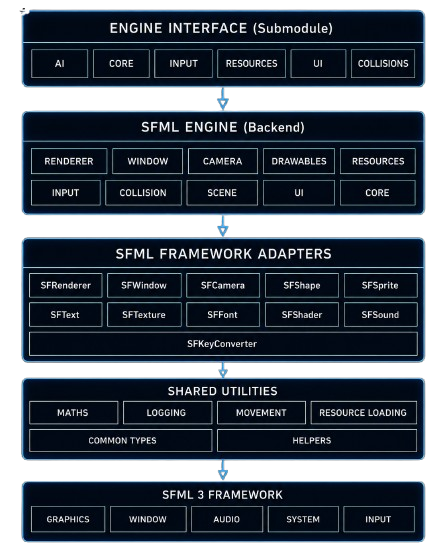
Each subsystem focuses on a specific responsibility and communicates through the interface layer, ensuring that applications remain independent of SFML while benefiting from its rendering and multimedia capabilities.
Core Framework
The backend is organised into three focused areas that translate the Engine Interface contracts into concrete SFML implementations. Each area groups related responsibilities while keeping framework-specific functionality isolated from application code.

Rendering & Windowing
Implements rendering, window management, cameras and drawable objects through the Engine Interface contracts. These systems translate backend-independent rendering requests into SFML operations while keeping framework-specific graphics functionality isolated from the app.

Resources & Media
Implements textures, fonts, shaders, sound and music services through the Engine Interface contracts. These systems manage resource loading, ownership and lifetime while keeping framework-specific multimedia functionality isolated from application code across application systems.

Input & World Systems
Implements input translation, collision grids and tile-based world components through the Engine Interface contracts. These systems support interaction, spatial management and gameplay functionality while keeping framework-specific behaviour isolated from application code safely.
Together, these systems provide the concrete services required by higher-level applications while preserving the separation between application logic and the underlying multimedia framework.
Engineering Principles
| Principle | Application |
| Dependency Inversion | Applications depend on Engine Interface abstractions rather than SFML implementations. |
| Backend Encapsulation | SFML is isolated entirely within the backend implementation. |
| Modularity | Rendering, resources, input and world systems are implemented as independent services. |
| Single Responsibility | Each implementation focuses on one interface and one responsibility. |
| Reusability | The backend can be reused across multiple projects implementing Engine Interface. |
| Maintainability | Backend services can be extended or replaced without impacting application code. |
Key Design Decisions
One-to-One Implementations
Each Engine Interface contract is implemented by a dedicated SFML class, maintaining clear responsibility boundaries and ensuring consistent behaviour across backend services.
Framework Encapsulation
All SFML-specific types and functionality remain contained within the backend, preventing framework dependencies from propagating into application or engine code.
Modular Backend Systems
Rendering, resources, input and world systems are organised into cohesive subsystems, improving maintainability while supporting independent development and future extension.
Shared Architecture
Engine Interface is integrated as a Git submodule, ensuring implementation consistency while allowing the interface layer and backend to evolve together without duplication.
Technologies
Development
C++ 20
Visual Studio 2022
Git
Git Submodules
Engineering Approach
Interface-Driven Architecture
RAII
Dependency Inversion
Backend Abstraction
Resource encapsulation
Modular Architecture
Layered Architecture
Contract-Based Design
Engineering Outcome
Engine SFML Backend demonstrates how a modern C++ application can utilise a third-party multimedia framework without becoming tightly coupled to it. By implementing the contracts defined by Engine Interface, the project provides a reusable backend that supports clean architecture, modular development and future extensibility while serving as the foundation for higher-level applications such as Pong.
Repository
Explore the source code to see how the architectural principles are implemented throughout the framework.

Engineering Review
Read the accompanying architecture review for a detailed discussion of the design decisions, implementation strategy and engineering trade-offs behind the project.